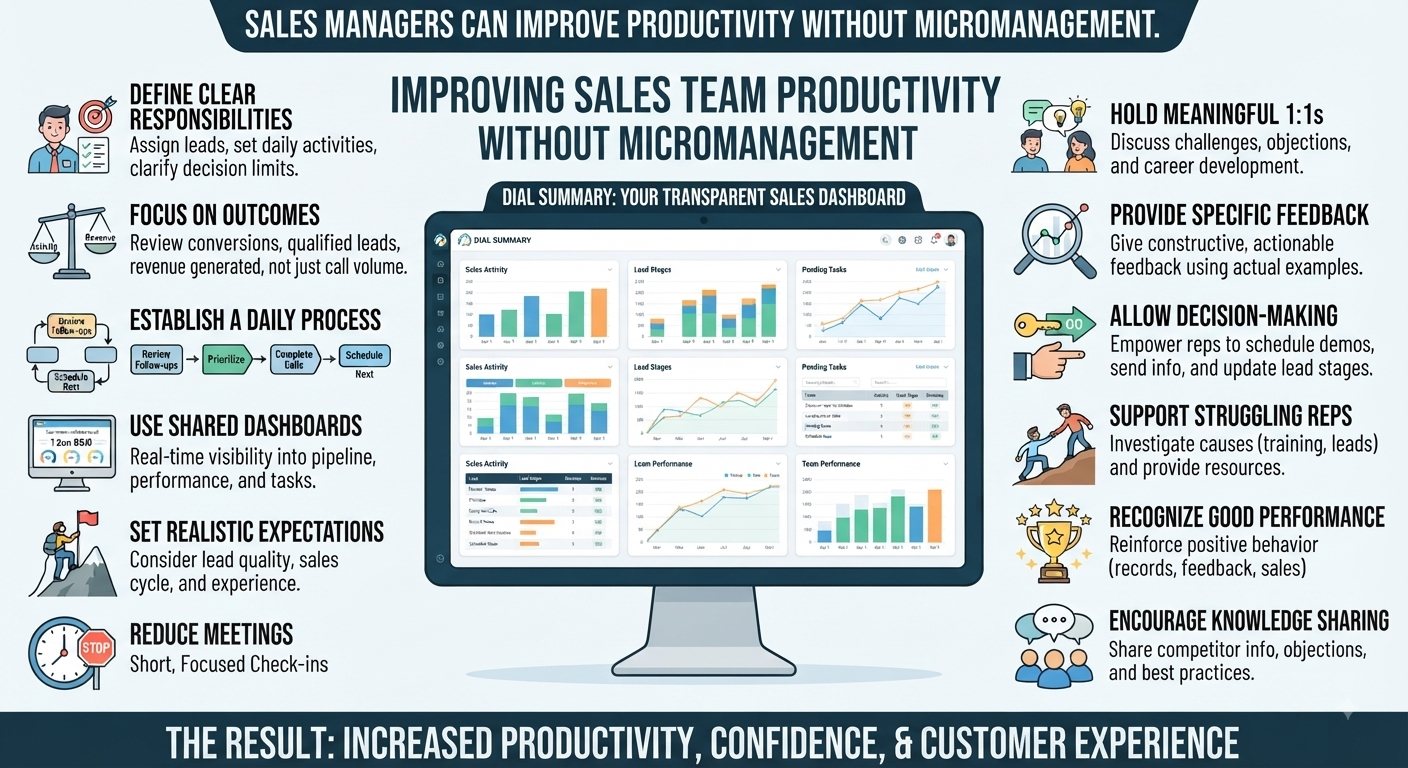
How Sales Managers Can Improve Team Productivity Without Micromanagement
How Sales Managers Can Improve Team Productivity Without Micromanagement
Sales managers are responsible for achieving business targets, supporting employees, maintaining customer relationships, and ensuring that important opportunities receive proper attention.
To meet these responsibilities, managers need visibility into the team’s daily work. However, continuously calling employees for updates, monitoring every activity, or controlling every decision can reduce confidence and productivity.
The solution is not to stop monitoring performance. The solution is to create a transparent system in which expectations, responsibilities, and results are clearly visible.
This allows managers to support their teams without micromanaging them.
What Is Micromanagement?
Micromanagement happens when a manager controls or monitors employees more closely than necessary.
Examples may include:
- Repeatedly asking employees for activity updates
- Requiring approval for minor decisions
- Monitoring every call without a clear reason
- Focusing only on working hours instead of outcomes
- Giving employees little freedom to solve customer problems
- Changing priorities without explanation
- Correcting small details that do not affect results
- Conducting unnecessary status meetings
- Expecting immediate responses to every internal message
Managers may behave this way because they want better results or fear that work will be missed. However, excessive control often creates the opposite result.
How Micromanagement Affects Sales Teams
Sales work requires confidence, communication, judgement, and the ability to respond to different customer situations.
Micromanagement can negatively affect these qualities. It may lead to:
- Lower employee confidence
- Slower decision-making
- Reduced ownership
- Increased stress
- Less creativity
- Poor manager-employee relationships
- Higher employee turnover
- Unnecessary administrative work
- Reduced customer focus
Employees may begin working only to satisfy the manager instead of focusing on customer needs and sales outcomes.
Define Clear Responsibilities
Employees perform better when they understand exactly what they are responsible for.
Each representative should know:
- Which leads they own
- Which customer segment they handle
- What daily activities are expected
- When new leads should be contacted
- How follow-ups should be recorded
- When a manager should be involved
- Which decisions they can make independently
- How success will be measured
Clear responsibilities reduce confusion and prevent managers from needing to provide constant instructions.
Focus on Outcomes, Not Constant Activity
Call volume and working hours can provide useful context, but they should not be the only measures of productivity.
Sales managers should also review outcomes such as:
- Leads contacted successfully
- Follow-ups completed
- Qualified opportunities
- Demonstrations scheduled
- Quotations shared
- Customer response rates
- Sales conversions
- Revenue generated
- Customer retention
- Accuracy of lead information
An employee may make fewer calls but generate more meaningful conversations. Another may make many calls without completing follow-ups.
Evaluating outcomes creates a more balanced understanding of performance.
Establish a Simple Daily Process
A structured daily routine reduces the need for constant supervision.
A representative’s daily process may include:
- Review overdue follow-ups.
- Check new assigned leads.
- Prioritise urgent opportunities.
- Complete scheduled calls.
- Record conversation notes.
- Update lead stages.
- Schedule the next action.
- Review pending tasks before finishing the day.
When employees follow a consistent process, managers can focus on exceptions and support instead of checking every activity.
Use Shared Dashboards
A shared dashboard gives managers visibility without repeatedly asking employees for reports.
It may show:
- Daily calling activity
- New and assigned leads
- Pending follow-ups
- Overdue tasks
- Missed calls
- Lead stages
- Team performance
- Recent customer activity
Managers can review the overall situation and contact employees only when assistance or clarification is required.
Employees also benefit because they can see their priorities and progress.
Set Realistic Performance Expectations
Unrealistic targets often create pressure without improving productivity.
Targets should consider:
- Number of available leads
- Product complexity
- Average sales cycle
- Customer response rates
- Representative experience
- Market conditions
- Time required for demonstrations or proposals
- Existing customer responsibilities
Managers should explain how targets were created and what employees can do to achieve them.
Fair targets are more motivating because employees understand that success is possible.
Reduce Unnecessary Meetings
Meetings can support coordination, but too many meetings reduce the time available for customer conversations and follow-ups.
Before scheduling a meeting, managers should ask:
- Is a meeting necessary?
- Can the information be shared through a dashboard or message?
- Does every invited employee need to attend?
- Is there a clear agenda?
- Is a decision required?
- Can the meeting be completed within 15 or 20 minutes?
Short, focused meetings are often more useful than long daily discussions.
A weekly sales review may be enough when team activity and lead information are already updated in a shared system.
Hold Meaningful One-to-One Meetings
One-to-one meetings should not be used only for checking targets. They should help employees solve problems and improve.
Useful discussion topics include:
- Current challenges
- Important opportunities
- Customer objections
- Training requirements
- Workload concerns
- Process improvements
- Career development
- Support required from management
Managers should listen carefully and avoid turning every conversation into criticism.
Employees are more likely to share problems when they know the discussion will be constructive.
Provide Specific Feedback
General feedback such as “work harder” or “improve your calls” does not tell employees what needs to change.
Specific feedback is more effective.
For example:
“You are contacting new leads quickly, but several follow-up dates are not being recorded. Please confirm the next action before closing each lead update.”
This feedback identifies both the positive behaviour and the area that requires improvement.
Managers should use actual examples and explain how the change will improve results.
Allow Employees to Make Decisions
Employees need reasonable authority to handle customer conversations effectively.
Managers should define which decisions representatives can make independently, such as:
- Scheduling demonstrations
- Sending approved product information
- Arranging follow-up calls
- Updating lead stages
- Handling common customer questions
- Offering standard pricing plans
- Escalating technical or billing issues
When every small decision requires manager approval, customers experience delays and employees lose confidence.
Clear limits allow representatives to work independently while protecting the business.
Support Employees Who Are Struggling
Low performance does not always mean that an employee lacks effort.
Possible reasons may include:
- Insufficient training
- Poor-quality leads
- Technical difficulties
- Unclear responsibilities
- Excessive workload
- Lack of product knowledge
- Personal challenges
- Ineffective sales scripts
- Incorrect customer targeting
Managers should investigate the cause before deciding on corrective action.
Support may include additional training, call guidance, revised lead assignments, better tools, or temporary workload adjustments.
Recognise Good Performance
Recognition helps reinforce positive behaviour.
Managers can recognise employees for:
- Consistent follow-ups
- Accurate lead records
- Strong customer feedback
- Successful sales
- Improvement over time
- Helping team members
- Recovering missed opportunities
- Maintaining professional communication
Recognition does not always require financial rewards. A sincere message, team announcement, certificate, or additional responsibility can also be meaningful.
The recognition should be specific so employees understand what they did well.
Encourage Knowledge Sharing
Sales representatives regularly learn useful information from customer conversations.
They may discover:
- Common customer questions
- New objections
- Competitor information
- Effective explanations
- Industry-specific requirements
- Successful follow-up methods
- Product improvement suggestions
Managers should create opportunities for employees to share this knowledge.
A short weekly session or shared document can help the entire team benefit from individual experiences.
Maintain Accurate Customer and Lead Information
Managers cannot make good decisions when records are incomplete.
Representatives should update:
- Customer contact details
- Conversation notes
- Lead status
- Follow-up dates
- Documents shared
- Customer objections
- Expected decision date
- Reasons for won or lost opportunities
Accurate records reduce the need for managers to ask employees for repeated explanations.
They also ensure that another team member can assist the customer when necessary.
Use Performance Data Responsibly
Performance data should be used to identify patterns and provide support. It should not be used to create fear.
Managers should avoid comparing employees without considering factors such as:
- Lead quality
- Territory
- Experience
- Product type
- Customer segment
- Assigned responsibilities
Data should begin a conversation, not automatically determine a conclusion.
For example, lower call volume may indicate poor effort, but it may also mean that the representative is conducting longer demonstrations or handling complex accounts.
Give Employees Time to Improve
Improvement does not happen immediately after one training session or feedback conversation.
Managers should:
- Explain the required change.
- Agree on a practical action plan.
- Provide training or resources.
- Set a reasonable review period.
- Monitor progress.
- Discuss results.
- Adjust the plan if necessary.
This approach creates accountability while giving employees a fair opportunity to improve.
How Dial Summary Supports Sales Managers
Dial Summary helps managers review calling and lead activity from a shared platform.
Managers and teams can use Dial Summary to:
- Review daily call activity
- Monitor missed calls
- Organise lead information
- Track follow-up requirements
- Understand team calling patterns
- Maintain customer notes
- Identify pending work
- Improve visibility across the sales process
This shared visibility reduces the need for repeated status requests and allows managers to focus on coaching, planning, and important customer opportunities.
Conclusion
Sales productivity improves when employees understand their responsibilities, have access to useful information, and receive the right level of support.
Managers do not need to control every activity to maintain accountability. Clear expectations, shared dashboards, meaningful performance measures, and regular constructive feedback can provide the necessary visibility.
The most effective sales managers create an environment where employees can work independently while knowing that support is available when required.
By replacing constant supervision with structured processes and transparent information, businesses can improve productivity, strengthen employee confidence, and deliver a better customer experience.