A Complete Guide to Managing a High-Performing Telecalling Team | DialSummary Blog
11 min read 0 views

A Complete Guide to Managing a High-Performing Telecalling Team

By amey shinde

A Complete Guide to Managing a High-Performing Telecalling Team

Telecalling remains an important sales and customer communication channel for businesses across industries.

Real estate companies use calling teams to qualify property enquiries. Financial service providers contact customers about loans and insurance products. Educational institutions follow up with prospective students, while service businesses use phone calls to schedule appointments and resolve customer concerns.

Although telecalling appears straightforward, managing a telecalling team effectively can be challenging. Managers must balance daily activity targets, conversation quality, follow-up discipline, employee motivation, customer experience, and data accuracy.

A successful telecalling team is not simply a group of people making a large number of calls. It is an organised operation in which every employee understands the objective, follows a reliable process, records useful information, and knows what action to take after each conversation.

This guide explains how businesses can build and manage a productive telecalling team without creating unnecessary pressure or relying entirely on manual reporting.

1. Define the Purpose of Your Telecalling Team

Before setting targets, businesses must clearly define why the team is making calls.

A telecalling team may be responsible for:

  • Contacting new sales leads
  • Qualifying potential customers
  • Scheduling product demonstrations
  • Following up on quotations
  • Renewing subscriptions
  • Collecting customer feedback
  • Confirming appointments
  • Recovering missed opportunities
  • Supporting existing customers
  • Re-engaging inactive prospects

When employees handle several call types without clear priorities, their daily work becomes confusing. A salesperson may spend too much time on low-priority calls while a highly interested lead waits for a response.

Managers should separate calling activities into clear categories and define the expected result for each category.

For example, the objective of a new-lead call may be to understand the customer’s requirement and schedule a demonstration. The objective of a follow-up call may be to answer pending questions and confirm the next decision date.

Clear objectives allow employees to have more focused conversations.

2. Create a Consistent Lead Assignment Process

Leads should not be distributed randomly without considering workload, experience, location, language, or product knowledge.

A structured assignment process can consider:

  • Current workload of each employee
  • Employee specialisation
  • Lead source
  • Customer location
  • Preferred language
  • Product or service category
  • Lead priority
  • Previous customer interactions

Every lead should have a clearly assigned owner. This prevents duplicate calls and ensures accountability.

Managers should also define when a lead can be reassigned. A lead may need to move to another employee if:

  • The original owner is unavailable.
  • The customer requires specialised assistance.
  • Repeated follow-ups remain incomplete.

The assignment history should remain visible so the new employee understands what has already happened.

3. Define Standard Lead Stages

A common mistake is allowing every employee to describe lead status differently.

One employee may use “interested,” another may write “call later,” and someone else may leave the status empty.

Standard lead stages create a shared language across the team.

A simple structure may include:

  • New
  • Contact attempted
  • Connected
  • Qualified
  • Follow-up scheduled
  • Demonstration or meeting scheduled
  • Quotation shared
  • Negotiation
  • Converted
  • Not interested
  • Unreachable
  • Closed or disqualified

The exact stages should reflect the company’s sales process. Avoid creating too many stages, as complicated systems are difficult to maintain.

Employees should understand what each stage means and what information is required before moving a lead forward.

For example, a lead should not be marked as qualified only because the customer answered the phone. Qualification should be based on relevant requirements, interest, authority, budget, timeline, or another business-specific condition.

4. Build a Reliable Follow-Up Process

Many potential customers do not make a decision during the first conversation. They may need time to compare products, consult other decision-makers, arrange a budget, or understand the service more clearly.

This makes follow-up one of the most important parts of telecalling.

Every meaningful conversation should end with a clear next step:

  • Call again on a specific date
  • Send pricing information
  • Share a brochure
  • Schedule a demonstration
  • Arrange a meeting
  • Answer a technical question
  • Wait for customer confirmation
  • Close the lead with an appropriate reason

A follow-up date should not be stored only in an employee’s memory or personal notebook. It should be recorded in a shared system where both the employee and manager can track it.

Managers should review overdue follow-ups regularly. The purpose is not to create fear but to identify why actions remain incomplete.

Possible reasons include:

  • Excessive workload
  • Unclear ownership
  • Missing information
  • Incorrect contact details
  • A process that requires too many manual steps

5. Set Balanced Performance Metrics

Call count is useful, but it should never be the only measure of performance.

An employee can make many short, low-quality calls without creating meaningful business opportunities. Another employee may make fewer calls but handle longer consultations that lead to demonstrations or sales.

A balanced performance framework may include:

  • Calls attempted
  • Calls connected
  • Meaningful conversations
  • Missed calls returned
  • Follow-ups completed
  • Qualified leads
  • Meetings or demonstrations scheduled
  • Quotations shared
  • Conversions
  • Customer complaints
  • Data completeness

Managers should connect metrics to the employee’s role. A customer-support representative should not be evaluated using exactly the same measurements as a sales-development representative.

Performance should also be reviewed over a reasonable period. One difficult day does not define an employee’s ability. Weekly and monthly patterns provide more useful context.

6. Focus on Conversation Quality

A telecalling script can help employees remain consistent, but it should not make conversations sound robotic.

A useful call structure includes:

Introduction

The employee should introduce themselves and the company clearly. The customer should understand why they are being contacted.

Permission and Context

Whenever appropriate, ask whether it is a suitable time to speak. Mention the enquiry, previous conversation, or source of contact.

Discovery

Use open questions to understand the customer’s actual requirement.

Examples include:

  • What problem are you currently trying to solve?
  • How are you managing this process today?
  • What is the biggest difficulty your team faces?
  • Who will be using the solution?
  • When are you planning to make a decision?

Explanation

The employee should connect the product or service to the customer’s requirement instead of listing every available feature.

Confirmation

Summarise what the customer needs and confirm that the understanding is correct.

Next Step

Every productive call should conclude with a specific action and timeline.

Managers can use call reviews, role-play sessions, and customer feedback to improve conversation quality.

7. Provide Regular Coaching

Training should not end after an employee joins the company. Telecalling skills improve through practice, feedback, and reflection.

Weekly coaching sessions can cover:

  • Opening a conversation confidently
  • Asking better questions
  • Listening without interruption
  • Explaining value clearly
  • Handling common objections
  • Managing difficult customers
  • Confirming follow-up actions
  • Writing useful notes
  • Respecting customer preferences

Coaching should use specific examples.

Instead of telling an employee to “communicate better,” explain what happened and what alternative approach could improve the conversation.

For example:

“During the pricing discussion, the customer asked about implementation time. Before returning to pricing, explain the onboarding steps and confirm the customer’s expected launch date.”

Specific feedback is easier to understand and apply.

8. Use Technology to Reduce Manual Work

Telecalling teams often lose productive time preparing reports, updating spreadsheets, searching for customer information, and remembering follow-ups.

A call management and analytics platform can help organise:

  • Incoming and outgoing call activity
  • Missed calls
  • Call duration
  • Lead ownership
  • Customer history
  • Follow-up reminders
  • Lead notes
  • Team performance reports
  • Call recordings, where permitted
  • Daily and monthly summaries

Automation should support the employee rather than make the process complicated.

The best system is one the team can use consistently during normal work.

Dial Summary helps calling-focused teams organise call activity, leads, follow-ups, and performance information in one place. Managers gain visibility into daily operations while employees spend less time preparing repetitive reports.

9. Protect Customer Privacy

Telecalling operations involve personal information such as names, phone numbers, email addresses, conversation notes, and sometimes recordings.

Businesses should establish clear privacy practices:

  • Collect only necessary information
  • Restrict access based on employee roles
  • Protect login credentials
  • Avoid sharing customer details through unauthorised channels
  • Define data-retention rules
  • Obtain consent where required
  • Follow applicable call-recording laws
  • Remove access when an employee leaves
  • Investigate unusual data activity
  • Train employees on confidentiality

Call recordings require particular care. Recording rules vary by location and use case.

Businesses should review applicable laws and provide appropriate disclosure or obtain consent when required.

Technology can support security, but employees and managers must also follow responsible data-handling practices.

10. Create a Healthy Performance Culture

Excessive pressure may increase call numbers temporarily, but it can reduce conversation quality, employee confidence, and customer trust.

Managers should create a culture that values:

  • Honest reporting
  • Respectful customer communication
  • Timely follow-ups
  • Continuous learning
  • Accurate information
  • Team collaboration
  • Responsible data handling
  • Sustainable performance

Employees should feel comfortable reporting obstacles.

If a campaign has poor-quality leads or incorrect phone numbers, the team should be able to raise the issue without being blamed for low connections.

Recognise positive behaviour such as:

  • Complete notes
  • Customer appreciation
  • Consistent follow-ups
  • Improvement after coaching
  • Support provided to other team members

11. Conduct Useful Team Reviews

A daily review should be brief and operational.

It can focus on:

  • Priority leads
  • Follow-ups due today
  • Important missed calls
  • Customer issues
  • Meetings scheduled
  • Support required

A weekly review can examine broader patterns:

  • Lead conversion movement
  • Follow-up completion
  • Connection patterns
  • Individual workload
  • Common objections
  • Campaign performance
  • Training needs

A monthly review can address strategy:

  • Which lead sources perform best?
  • Which products receive the strongest interest?
  • Where do leads usually stop progressing?
  • Are response times improving?
  • Which processes still depend on manual work?
  • Does the team require additional staffing or training?

Review meetings should end with clear actions. Reports are valuable only when they lead to better decisions.

12. Avoid Common Telecalling Management Mistakes

Businesses should watch for these common problems:

Measuring Only Call Volume

More calls do not automatically produce better results.

Ignoring Missed Calls

An unanswered call may represent a customer who is ready to act.

Allowing Unclear Lead Ownership

When responsibility is uncertain, follow-ups are delayed.

Using Too Many Lead Stages

An overly complicated process discourages accurate updates.

Providing Only Negative Feedback

Employees need recognition and practical coaching, not constant criticism.

Maintaining Separate Personal Records

Important customer information should remain available to authorised team members.

Failing to Review the Sales Process

A team cannot consistently perform well when the underlying workflow is unclear.

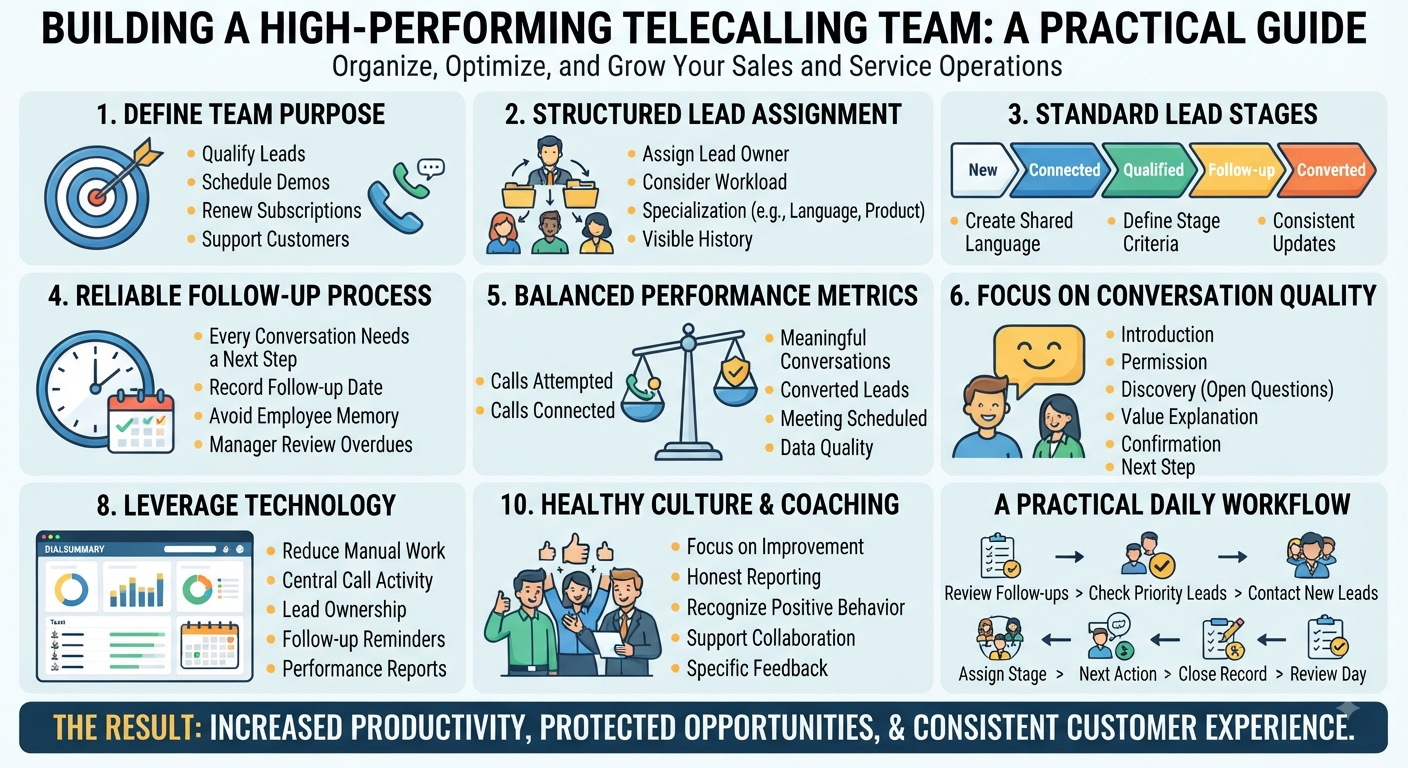
A Practical Daily Workflow

A well-organised telecaller can follow this routine:

  1. Review scheduled follow-ups.
  2. Check priority leads and missed calls.
  3. Contact new leads within the expected response time.
  4. Record the result of every meaningful conversation.
  5. Assign the correct lead stage.
  6. Schedule the next action before closing the record.
  7. Complete pending messages, quotations, or demonstrations.
  8. Review incomplete activities before ending the day.

Managers can support this workflow by keeping assignments realistic and removing unnecessary reporting tasks.

Final Thoughts

A high-performing telecalling team requires more than calling targets. It needs clear objectives, consistent lead stages, reliable follow-ups, meaningful analytics, regular coaching, and responsible customer-data practices.

Managers should use technology to create visibility and reduce repetitive work, but they should also remember that every successful customer interaction depends on human communication.

The strongest teams combine disciplined processes with helpful conversations. They know which customers require attention, what happened during previous interactions, and what action must happen next.

By creating a transparent and supportive calling operation, businesses can improve employee productivity, protect sales opportunities, and deliver a more consistent customer experience.

Share: