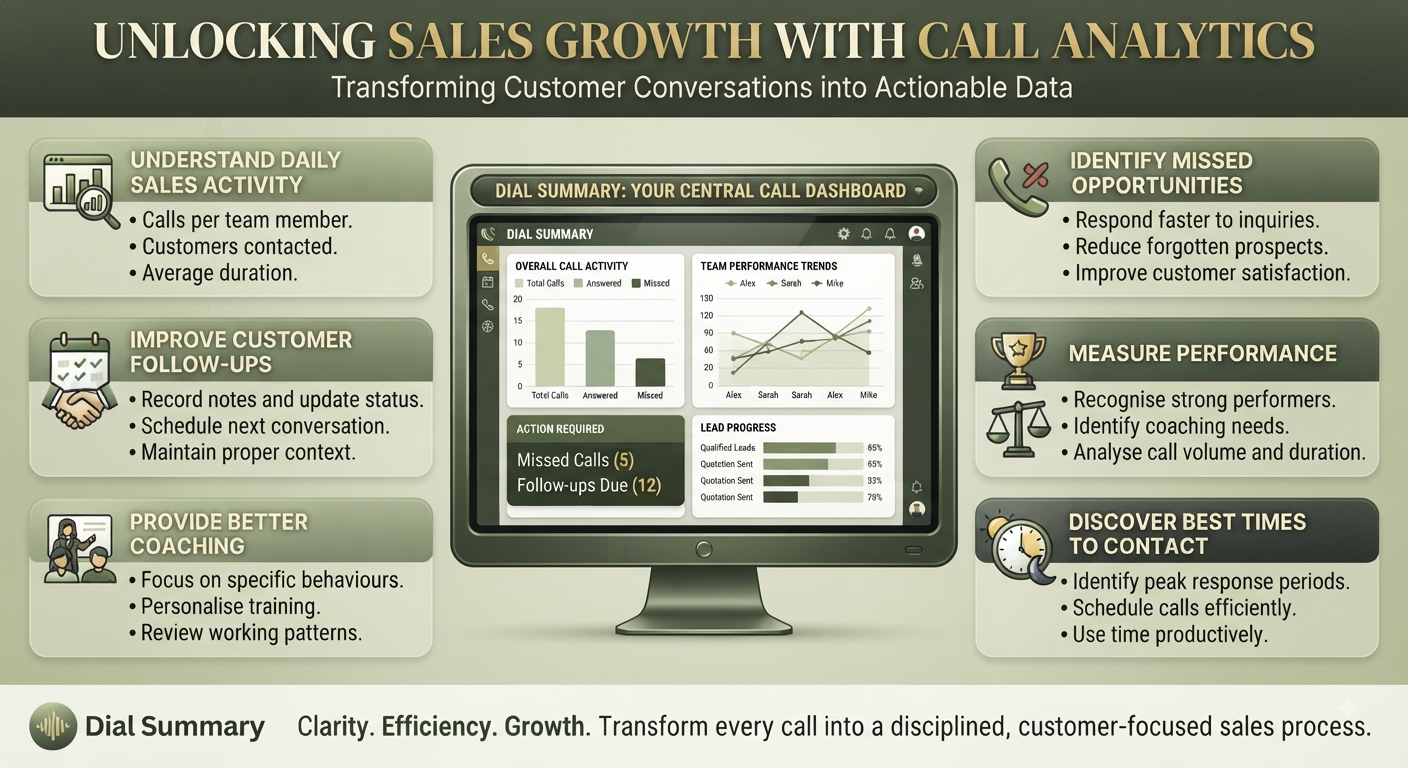
How Call Analytics Helps Sales Teams Improve Performance
How Call Analytics Can Transform Your Business Growth
Every customer conversation provides valuable information. However, many sales teams complete hundreds of calls every week without properly analysing what happened during those conversations.
They may know the total number of calls made, but they often do not know which calls produced leads, which customers require follow-ups, or which team members need additional support.
Call analytics helps businesses convert everyday calling activity into useful information. It gives managers and sales representatives a clearer understanding of team performance, customer engagement, and follow-up opportunities.
What Is Call Analytics?
Call analytics is the process of collecting and analysing information related to business calls.
Depending on the tools being used, this information may include:
- Total incoming and outgoing calls
- Answered and missed calls
- Call duration
- Call time and date
- Customer follow-up status
- Sales representative activity
- Lead progress
- Team performance trends
Instead of manually checking call logs or asking every employee for updates, managers can use a call analytics dashboard to review important information from one place.
Understand Daily Sales Activity
A sales manager needs to know how actively the team is communicating with prospects and customers.
Without reliable call information, it becomes difficult to understand whether the team is reaching enough people or spending time on the right opportunities.
Call analytics helps managers monitor:
- The number of calls made by each team member
- The number of customers contacted
- The average duration of conversations
- Missed or unanswered calls
- Follow-up activity
- Changes in calling performance over time
This visibility allows managers to make decisions using actual activity instead of assumptions.
Identify Missed Opportunities
A missed call can represent a missed sales opportunity. Customers may call to ask about pricing, product availability, demonstrations, support, or order status.
If the call is not tracked and followed up, the customer may contact another business.
Call analytics makes missed calls easier to identify. Team members can review pending calls and contact customers before the opportunity becomes cold.
A structured missed-call process can help a business:
- Respond to customers more quickly
- Reduce forgotten enquiries
- Improve customer satisfaction
- Increase the chances of lead conversion
- Maintain a professional customer experience
Even a simple daily review of missed calls can produce meaningful improvements.
Improve Customer Follow-Ups
Consistent follow-up is one of the most important parts of sales. A customer may not be ready to purchase during the first conversation.
They may ask the sales representative to call again after a few days, share more information, or arrange a demonstration.
When follow-up information is managed through notebooks, spreadsheets, or personal reminders, important tasks can easily be forgotten.
A call analytics and lead management platform allows representatives to connect calling activity with follow-up actions. They can record notes, update lead status, and plan the next conversation.
This creates a more organised process:
- Contact the prospect.
- Record the result of the conversation.
- Update the lead status.
- Schedule the next follow-up.
- Review pending follow-ups regularly.
- Continue the conversation with proper context.
Customers receive a more consistent experience because representatives know what was discussed previously.
Measure Individual and Team Performance
Every sales team includes people with different strengths. Some representatives may complete many short calls, while others may spend more time understanding customer requirements.
Call numbers alone do not always provide a complete picture.
Call analytics allows managers to review multiple performance indicators, such as:
- Call volume
- Answered-call percentage
- Average conversation duration
- Follow-up completion
- Lead movement
- Customer response patterns
- Consistency across days or weeks
These insights help managers recognise strong performers and identify employees who may need additional coaching.
The purpose should not be to monitor employees unfairly. The objective should be to understand working patterns and provide the right support.
Provide Better Sales Coaching
General advice such as “make more calls” or “improve communication” is rarely enough to help a representative improve.
Coaching becomes more effective when it is based on specific information.
For example, call analytics may show that:
- A representative makes enough calls but completes very few follow-ups.
- Calls are ending before the customer’s requirements are understood.
- Most calls are happening at times when customers are less responsive.
- A team member is handling existing customers well but struggling with new leads.
- Certain representatives consistently convert more conversations into opportunities.
Managers can use these patterns to provide targeted coaching.
This makes training more practical, measurable, and relevant to each employee.
Discover the Best Times to Contact Customers
Customers may respond differently depending on the time of day, day of the week, industry, and location.
Calling at the wrong time can lead to unanswered calls and low engagement.
By reviewing historical call activity, sales teams can identify periods when customers are more likely to answer and participate in meaningful conversations.
Teams can then schedule important calls during productive periods and use less responsive periods for:
- Updating lead information
- Reviewing pending tasks
- Preparing quotations
- Sending follow-up messages
- Planning upcoming conversations
This helps representatives use their working hours more efficiently.
Improve Lead Prioritisation
Not every lead requires the same level of attention. Some prospects may be actively evaluating the product, while others may only be collecting basic information.
Call analytics becomes more useful when it is connected with lead management.
Representatives can review recent communication, call frequency, notes, and follow-up status before deciding which prospects to contact first.
A practical lead-prioritisation process may consider:
- How recently the customer was contacted
- Whether the customer requested a callback
- The outcome of previous conversations
- The customer’s level of interest
- Whether important information is pending
- How long the lead has remained inactive
This allows teams to focus on promising opportunities without completely ignoring long-term prospects.
Create Accountability Without Micromanagement
Managers need visibility, but continuously asking employees for updates can interrupt work and create unnecessary pressure.
A shared call analytics dashboard reduces the need for repeated status meetings. Managers can review overall activity, while representatives can update lead information as part of their normal workflow.
This creates transparent accountability. Employees understand what needs attention, and managers can provide support based on visible information.
A good analytics system should help teams become more independent rather than making them feel constantly watched.
Make Decisions Using Reliable Data
Business decisions are often affected by incomplete reports or personal assumptions.
Call analytics provides a more reliable foundation for planning.
Management can use calling data to answer questions such as:
- Does the team need additional representatives?
- Are leads receiving timely follow-ups?
- Which periods generate the best customer response?
- Is the current sales process producing consistent activity?
- Where are potential customers being lost?
- Which employees require training or support?
These answers can guide staffing, training, scheduling, and sales strategy.
Improve Customer Experience
Customers expect businesses to remember previous conversations and respond without unnecessary delays.
Repeating the same information to multiple representatives creates frustration.
When call activity and lead notes are organised, representatives can understand the customer’s history before beginning the next conversation. They can continue from the previous discussion and provide a more personalised response.
This helps the business deliver:
- Faster follow-ups
- Better-informed conversations
- Fewer repeated questions
- More consistent communication
- A professional customer journey
A well-organised internal process usually results in a better external customer experience.
How Dial Summary Supports Calling Teams
Dial Summary helps businesses organise call activity, lead information, and follow-up workflows.
It provides teams with a clearer view of daily calling operations so that important customer conversations are easier to manage.
Businesses can use Dial Summary to:
- Review call activity
- Understand team calling patterns
- Identify missed calls
- Organise lead information
- Track follow-up requirements
- Improve visibility for managers
- Maintain a structured calling workflow
The platform is designed to make call-related information easier to understand and act upon.
Conclusion
Call analytics is not only about counting calls. It is about understanding customer communication and using that information to improve sales activity.
When teams can see missed opportunities, pending follow-ups, performance patterns, and lead progress, they can work with greater clarity.
Managers can provide better coaching, representatives can organise their work more effectively, and customers can receive faster and more consistent service.
For businesses that depend on phone conversations, call analytics can become an important part of building a disciplined, measurable, and customer-focused sales process.