How Call Tracking Software Helps Small Businesses Improve Sales and Customer Relationships | DialSummary Blog
10 min read 0 views

How Call Tracking Software Helps Small Businesses Improve Sales and Customer Relationships

By amey shinde

How Call Tracking Software Helps Small Businesses Improve Sales and Customer Relationships

Running a small business often means managing sales, customer service, operations, and team performance at the same time.

Phone calls remain one of the most important communication channels for many businesses, especially those working in real estate, insurance, financial services, healthcare, education, home services, retail, and customer support.

A potential customer may call to ask about pricing, request a demonstration, confirm product availability, or discuss a service requirement. Every call can become a business opportunity.

However, when calls are not recorded properly, follow-ups are delayed, and managers have limited visibility into team activity, valuable opportunities can easily be lost.

Call tracking software helps businesses organise these conversations, monitor employee activity, manage follow-ups, and make better sales decisions.

This guide explains how call tracking works and how small businesses can use it to improve productivity, sales performance, and customer relationships.

What Is Call Tracking Software?

Call tracking software records and organises information related to business phone calls.

Depending on the system and device permissions, it may capture details such as:

  • Caller or contact information
  • Incoming and outgoing calls
  • Missed and rejected calls
  • Call date and time
  • Call duration
  • Employee responsible for the call
  • Follow-up status
  • Lead notes and outcomes
  • Call recordings, where permitted
  • Team and individual performance data

Instead of relying on handwritten notes or manually maintained spreadsheets, businesses receive structured call information in a central dashboard.

Call tracking is not only about counting calls. Its real purpose is to help a business understand what happened during customer communication and what action should happen next.

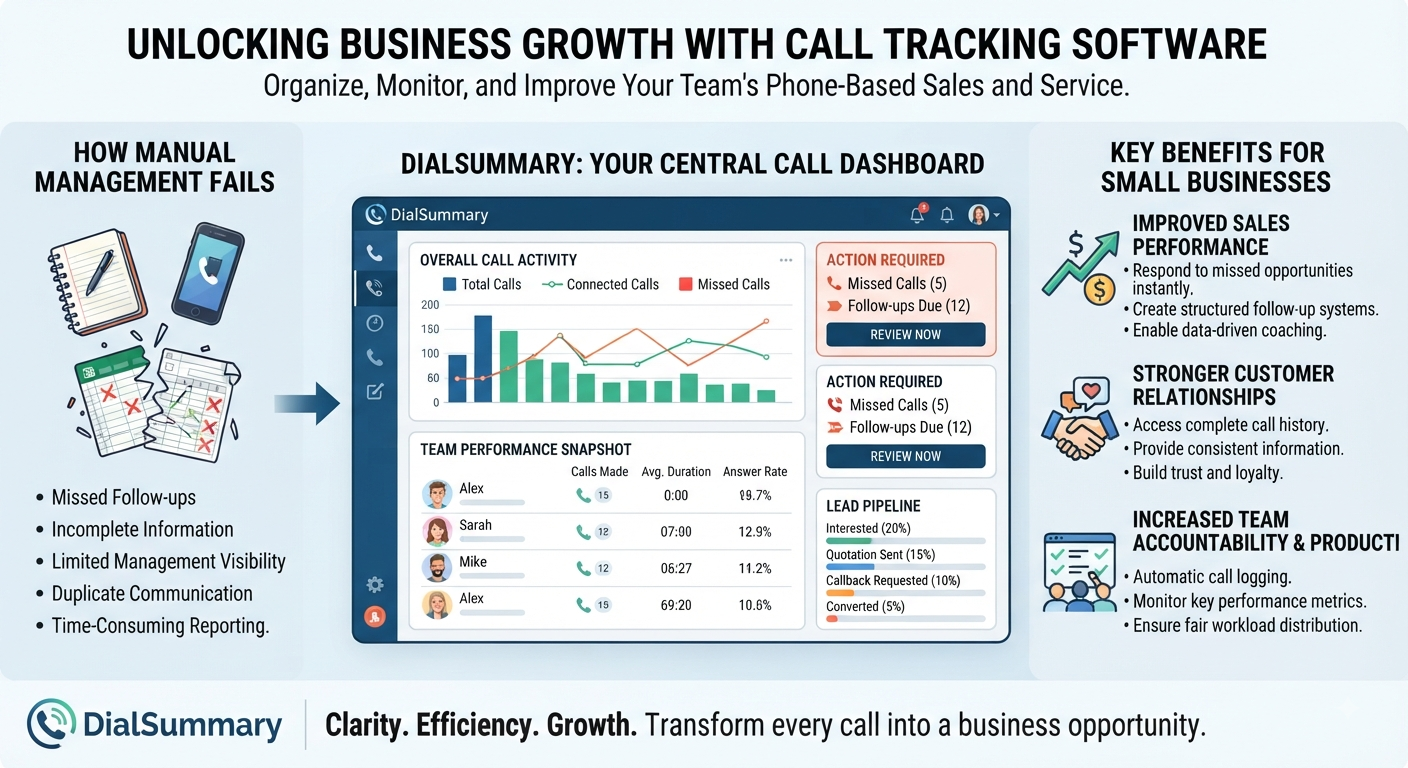
Why Manual Call Management Creates Problems

Many small businesses initially manage customer calls through personal phones, notebooks, messaging applications, or spreadsheets.

These methods may work when the business has only a few customers, but they become difficult to manage as the number of leads and team members increases.

Missed Follow-Ups

An employee may promise to call a prospect later but forget to create a reminder. The prospect may then choose a competitor who responds faster.

Incomplete Information

A spreadsheet may show a phone number but not explain when the customer was last contacted, what was discussed, or what the next step should be.

Limited Management Visibility

Managers may know the total number of sales but remain unaware of the daily activity behind those results.

They cannot easily identify missed calls, delayed responses, or employees who require additional support.

Duplicate Communication

Without a shared system, two employees may contact the same customer without knowing about each other’s conversations.

This can create confusion and reduce customer trust.

Time-Consuming Reporting

Employees may spend valuable time preparing daily call reports instead of speaking with customers and completing follow-ups.

Call tracking software reduces these problems by converting call activity into organised and actionable information.

How Call Tracking Improves Sales Performance

1. It Helps Businesses Respond to Missed Opportunities

A missed call may come from an existing customer, a qualified prospect, or someone ready to make a purchase.

If missed calls are not clearly visible, these opportunities can disappear.

A call tracking dashboard allows the team to identify unanswered calls and assign follow-up actions. This helps ensure that an important customer is not forgotten simply because the first call was missed.

The best practice is to create a clear process:

  1. Review missed calls regularly.
  2. Identify the responsible employee.
  3. Call the customer back promptly.
  4. Record the result.
  5. Schedule another follow-up when required.

This simple process can improve response consistency across the organisation.

2. It Creates a Structured Follow-Up System

Most sales are not completed during the first conversation.

Customers may need additional information, internal approval, a quotation, or time to compare available options.

Call tracking software helps employees record the outcome of each conversation and define the next action.

A prospect can be marked for:

  • A callback
  • A demonstration
  • A quotation
  • Negotiation
  • Future contact

A structured follow-up process gives every lead a clear position in the sales journey.

Employees know whom to contact, managers can monitor pending actions, and prospects receive communication at the appropriate time.

3. It Reduces Manual Data Entry

Manual reporting is repetitive and often inaccurate.

Employees may forget to enter calls, record incorrect durations, or submit reports at the end of the day when important details have already been forgotten.

Automatic call logging reduces this administrative burden. Basic call details can be captured without requiring employees to enter the same information repeatedly.

Employees can then focus on valuable information such as:

  • Customer requirements
  • Objections
  • Purchase intent
  • The agreed next step

4. It Improves Accountability

A shared call history creates transparency without requiring constant supervision.

Managers can review whether assigned leads were contacted, how many calls were completed, and whether promised follow-ups happened on time.

Accountability should not be used only to criticise employees. It should help managers identify obstacles and provide appropriate support.

For example:

  • An employee making many calls but achieving few meaningful conversations may need a better calling schedule or improved lead quality.
  • Another employee may have strong conversations but struggle to convert them into next steps.

Call data helps managers understand these differences.

5. It Supports Better Sales Coaching

General advice such as “make more calls” is rarely enough to improve performance.

Effective coaching should be based on observable behaviour.

Call analytics can help managers discuss:

  • The number of attempted calls
  • Customer answer rates
  • Average conversation duration
  • Missed-call response
  • Follow-up completion
  • Lead movement
  • Individual and team activity patterns

Where call recording is legally permitted and properly disclosed, selected conversations can also be reviewed for training and quality improvement.

Managers should use this information constructively.

The objective is to help employees improve communication, qualification, listening, and follow-up—not simply to increase call volume.

Important Call Metrics for Small Businesses

Businesses should avoid tracking every available number without understanding its purpose.

A smaller set of useful metrics is often more effective.

Total Calls

This indicates overall calling activity. It provides context but should not be treated as a complete performance measurement.

Connected Calls

A call attempt does not always result in a conversation. Connected calls show how often employees successfully reach customers.

Missed Calls

This metric reveals potential opportunities that require attention.

A rising number of missed calls may indicate staffing, availability, or response-process problems.

Call Duration

Duration can provide useful context, but longer calls are not automatically better. It should be considered alongside call purpose and outcome.

Follow-Ups Due

This shows how many prospects require further action.

Monitoring overdue follow-ups can prevent leads from becoming inactive.

Lead Outcomes

Businesses should record meaningful outcomes such as:

  • Interested
  • Callback requested
  • Quotation sent
  • Not interested
  • Unreachable
  • Converted

Response Time

The time taken to respond to a new enquiry or missed call can significantly affect the customer experience.

How Call Tracking Improves Customer Relationships

Customers expect businesses to remember previous conversations. Repeating the same information to different employees can be frustrating.

An organised call history gives the team useful context before speaking with a customer.

An employee can understand previous interactions, pending questions, and promised actions.

This creates several benefits:

  • Customers receive more consistent information.
  • Employees can continue conversations without starting again.
  • Commitments are easier to track.
  • Complaints can be investigated using reliable records.
  • Customers feel that the business understands their requirements.

Good customer relationships are built through consistency. Call tracking supports that consistency by making communication history accessible to authorised team members.

How Managers Can Use a Call Analytics Dashboard

A dashboard should help managers answer practical questions:

  • Are new leads being contacted?
  • Are missed calls being returned?
  • Which follow-ups are overdue?
  • Which employees may need coaching?
  • At what times are customers more likely to answer?
  • Which lead sources produce meaningful conversations?
  • Are customers receiving timely responses?
  • Is the team’s workload distributed fairly?

Managers should review trends rather than reacting to a single call or isolated number.

One unusual day may not indicate a serious problem, but repeated patterns can reveal where improvement is needed.

A weekly review can be used to:

  • Compare activity
  • Identify obstacles
  • Recognise good performance
  • Agree on the next actions

Choosing Call Tracking Software

Small businesses should select software based on actual operational needs rather than choosing the product with the longest feature list.

Consider the following questions:

Is the System Easy to Use?

Employees are more likely to adopt software that fits naturally into their daily work.

Does It Support Team Visibility?

Managers should be able to view relevant activity without collecting separate reports from every employee.

Can It Manage Follow-Ups?

Call data becomes more valuable when it connects directly to the next customer action.

Does It Provide Useful Analytics?

Reports should be understandable and connected to business decisions.

How Does It Protect Customer Information?

Access controls, secure storage, permissions, and privacy practices should be reviewed carefully.

Does It Match the Team’s Calling Process?

A small field-sales team may have different requirements from a large call centre.

The system should support the way the business actually communicates.

Implementing Call Tracking Successfully

Software alone cannot repair an unclear sales process.

Businesses should introduce call tracking with simple operating rules.

Define Call Outcomes

Create a standard list of outcomes so employees categorise calls consistently.

Establish Follow-Up Expectations

Specify when new enquiries, missed calls, and interested leads should be contacted again.

Train the Team

Explain how the system helps employees and customers.

Training should include both software usage and data responsibilities.

Review Only Meaningful Metrics

Focus on measurements that support decisions. Avoid creating pressure around numbers that do not reflect conversation quality.

Protect Customer Privacy

Collect only necessary information, restrict access, and follow applicable laws for call recording and personal data.

Improve the Process Continuously

Review results regularly and adjust scripts, schedules, lead assignments, and follow-up rules based on genuine patterns.

How Dial Summary Supports Call-Based Teams

Dial Summary is designed to help businesses organise calling activity, manage leads, track follow-ups, and understand team performance from one place.

Instead of preparing call reports manually, teams can use structured call information to identify missed opportunities and maintain a clearer customer history.

Managers gain visibility into calling activity, while employees receive a more organised way to manage daily conversations.

For small businesses, the main benefit is not complexity. It is clarity:

  • Knowing which calls happened
  • Knowing which customers require attention
  • Knowing what the team should do next

Final Thoughts

Phone conversations contain valuable business information.

When that information remains scattered across personal devices, notebooks, and spreadsheets, businesses lose visibility and employees lose time.

Call tracking software creates a more reliable process. It helps businesses respond to missed calls, complete follow-ups, monitor performance, and provide customers with consistent communication.

The most successful implementation combines technology with clear responsibilities.

Businesses should define their lead stages, follow-up rules, performance metrics, and privacy practices before expecting software to solve every problem.

When used thoughtfully, call tracking becomes more than a reporting tool. It becomes part of a disciplined customer-management system that helps small businesses protect opportunities, support their teams, and build stronger customer relationships.

Share: