How to Reduce Missed Calls and Capture More Business Opportunities | DialSummary Blog
9 min read 0 views

How to Reduce Missed Calls and Capture More Business Opportunities

By amey shinde

How to Reduce Missed Calls and Capture More Business Opportunities

Every missed business call can represent a customer enquiry, sales opportunity, support request, or important follow-up.

When calls are not tracked properly, businesses may lose potential customers without even knowing it. Customers usually expect a quick response. If one company does not answer, they may immediately contact another provider.

This makes missed-call management an important part of sales and customer service.

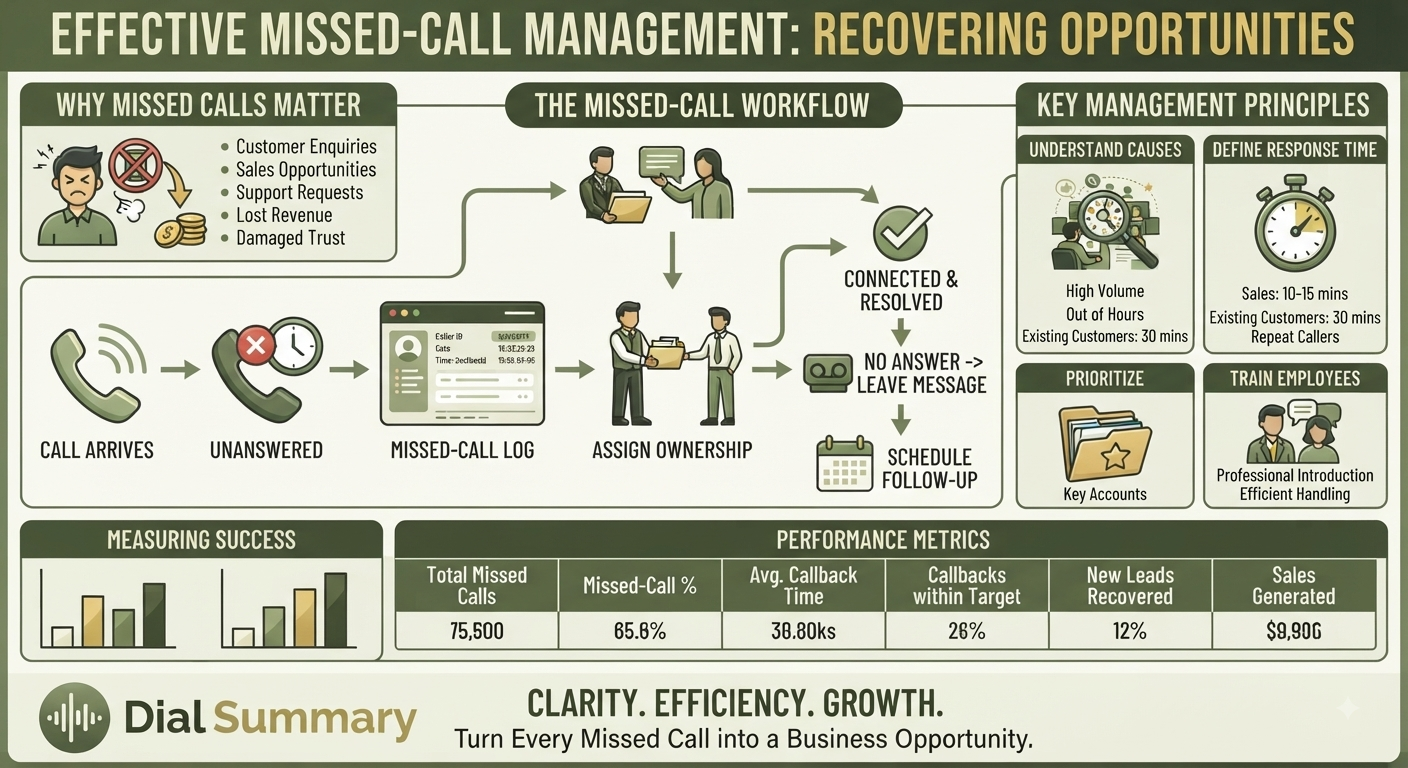
Reducing missed calls does not require employees to remain available every minute. It requires a structured process for identifying missed calls, assigning callbacks, recording outcomes, and measuring performance.

Why Missed Calls Matter

Customers make business calls for many reasons.

They may want to:

  • Ask about a product or service
  • Request pricing information
  • Schedule a demonstration
  • Confirm an appointment
  • Check an order or delivery
  • Report a problem
  • Discuss a quotation
  • Continue an earlier conversation
  • Contact a specific employee

When the business does not answer and fails to call back, the customer may feel ignored. The company may lose both immediate revenue and future trust.

A missed call should therefore be treated as an unfinished customer interaction rather than an unimportant call-log entry.

Understand Why Calls Are Being Missed

Before solving the problem, businesses need to understand why calls are not being answered.

Common reasons include:

  • Employees are already handling other calls.
  • Calls arrive outside working hours.
  • The assigned representative is unavailable.
  • Call volume is higher than the available team capacity.
  • Employees do not notice incoming calls.
  • The customer contacts an old or incorrect number.
  • Calls are not routed to the right department.
  • Team members are attending meetings or demonstrations.
  • There is no clear responsibility for handling incoming calls.
  • Representatives assume someone else will return the call.

Call records and team feedback can help management identify the most common causes.

Track Every Missed Call

A business cannot recover missed opportunities if it does not know which calls were missed.

The team should maintain a central view containing:

  • Caller’s phone number
  • Date and time of the call
  • Employee or department contacted
  • Number of call attempts
  • Whether the number belongs to an existing customer
  • Callback status
  • Name of the employee responsible for responding
  • Result of the callback

This information allows teams to separate pending calls from completed callbacks.

Create a Missed-Call Callback Process

A standard process helps employees respond consistently.

A practical missed-call workflow may include:

  1. Review missed calls regularly.
  2. Identify known customers and existing leads.
  3. Assign each callback to a team member.
  4. Call the customer as soon as possible.
  5. Introduce the business and mention the missed call.
  6. Understand the purpose of the customer’s call.
  7. Record the conversation outcome.
  8. Create or update the lead.
  9. Schedule another follow-up if required.
  10. Mark the callback as completed.

Without this process, several employees may call the same customer, or everyone may assume that someone else has handled the call.

Define an Expected Response Time

Businesses should decide how quickly missed calls should be returned. The target may depend on the team size and type of business.

For example:

  • High-priority sales enquiries: Within 10–15 minutes
  • Existing customer calls: Within 30 minutes
  • General enquiries: Within one business hour
  • Calls received outside working hours: Early on the next working day

These targets should be realistic and clearly communicated to the team.

A defined response time helps employees understand which callbacks require immediate attention.

Prioritise Important Callbacks

When several calls are missed, the team may not be able to return all of them immediately. Calls should therefore be prioritised.

High-priority callbacks may include:

  • Existing customers with active issues
  • Prospects who requested urgent information
  • Customers waiting for quotations
  • Scheduled follow-up calls
  • Calls from key accounts
  • Repeated calls from the same number
  • Customers near the final purchasing stage

Lower-priority calls can still be returned, but urgent opportunities should be handled first.

Assign Clear Ownership

Every missed call should have one responsible owner.

When ownership is unclear, common problems include:

  • Nobody calls the customer.
  • Several representatives call the same person.
  • The customer receives conflicting information.
  • Managers cannot identify pending work.
  • Follow-up records remain incomplete.

Assignment can be based on territory, department, lead owner, product, language, or employee availability.

If the assigned representative is unavailable, the call should be reassigned instead of remaining unattended.

Use a Professional Callback Introduction

Customers may not remember which company they contacted, especially when they called several businesses.

Representatives should use a clear and polite introduction:

“Hello, this is Priya from Dial Summary. We noticed that you called us earlier today, and I am returning your call. How may I help you?”

This approach immediately explains the reason for the call and makes the conversation feel professional.

Representatives should avoid beginning with unclear questions such as:

“Who is this?”

A good introduction creates a positive first impression.

Record the Callback Outcome

Completing a callback is not enough. The outcome should also be recorded.

Useful callback statuses may include:

  • Connected and enquiry resolved
  • New lead created
  • Existing lead updated
  • Follow-up scheduled
  • Quotation requested
  • Demonstration scheduled
  • Customer unavailable
  • Number busy
  • Incorrect number
  • Not interested
  • Support request assigned
  • Callback completed

Accurate statuses help managers understand how many missed calls became useful customer interactions.

Make Multiple Attempts Carefully

A customer may not answer the first callback. This does not always mean that they are no longer interested.

A simple attempt schedule may include:

  1. First attempt shortly after the missed call
  2. Second attempt later on the same day
  3. Third attempt on the next working day
  4. Final message through an appropriate channel, where consent permits

The business should avoid excessive calling. Repeated attempts within a short period may appear intrusive.

Each attempt should be recorded so that different employees do not repeat the same action.

Use Messages When Appropriate

If a customer does not answer the callback, a short message may help them recognise the number.

For example:

“Hello, this is the Dial Summary team. We noticed your call earlier and tried to contact you. Please reply with a convenient time, and our team will call you back.”

Messages should be clear, respectful, and sent only through channels permitted by the customer and applicable regulations.

Businesses should never send unnecessary promotional messages simply because someone made a call.

Monitor Calls Outside Working Hours

Calls received after business hours can still be valuable. The next working day should begin with a review of these calls.

Businesses can also communicate working hours clearly through:

  • Their website
  • Google Business Profile
  • WhatsApp Business profile
  • Email signatures
  • Automated call messages
  • Contact pages
  • Social media profiles

When customers know the operating hours, they have more realistic expectations.

Manage High Call Volumes

If many calls are missed during specific periods, the issue may be related to team capacity.

Managers can use call patterns to identify:

  • Peak calling hours
  • Busy days of the week
  • Seasonal increases
  • Campaign-related call volume
  • Departments receiving the most calls
  • Employees handling excessive workloads

The business can then adjust schedules, assign backup representatives, or distribute calls more effectively.

Train Employees to Handle Calls Efficiently

Long and unfocused calls can prevent representatives from answering other customers.

Training can help employees:

  • Understand customer requirements quickly
  • Ask clear questions
  • Provide accurate information
  • Take useful notes
  • Confirm the next action
  • End conversations professionally
  • Transfer calls appropriately
  • Avoid unnecessary waiting time

The objective is not to rush customers. It is to make conversations structured and productive.

Review Repeated Calls from the Same Number

Several missed calls from one number may indicate urgency.

The caller may be an existing customer, a highly interested prospect, or someone facing a serious problem.

Repeated callers should be prioritised.

Before returning the call, representatives should check whether the number already exists in the customer or lead database. This provides context and allows the employee to handle the conversation more effectively.

Connect Missed Calls with Lead Management

A missed call from an unknown number may be the beginning of a new sales opportunity.

When the customer confirms an interest in the business, the representative should create a lead record containing:

  • Customer name
  • Contact information
  • Requirement
  • Lead source
  • Conversation notes
  • Assigned representative
  • Lead status
  • Next follow-up date

This ensures that the enquiry continues through the normal sales process instead of disappearing after the callback.

Measure Missed-Call Performance

Businesses should monitor whether their callback process is improving.

Useful measurements include:

  • Total incoming calls
  • Number of missed calls
  • Missed-call percentage
  • Average callback time
  • Calls returned within the target time
  • Calls successfully connected
  • New leads created from missed calls
  • Sales generated from returned calls
  • Calls still awaiting action
  • Performance by team or representative

These figures help management identify process problems and training requirements.

How Dial Summary Helps Teams Manage Missed Calls

Dial Summary helps businesses review calling activity and identify calls that may require attention.

Teams can use Dial Summary to:

  • Review incoming and missed calls
  • Understand daily calling activity
  • Identify repeated calls
  • Connect customer conversations with lead records
  • Maintain notes and follow-up information
  • Monitor team activity
  • Improve callback accountability
  • Keep customer communication organised

A shared view of call activity makes it easier for managers and representatives to understand which opportunities still need action.

Conclusion

Missed calls are unavoidable in many businesses, but missed opportunities are not.

A structured callback process allows teams to identify unanswered calls, assign responsibility, contact customers quickly, and record the result.

It also helps managers understand why calls are being missed and where additional resources may be required.

Businesses that respond quickly and professionally demonstrate that they value customer time.

By treating every missed call as a potential opportunity, teams can improve customer experience, recover valuable enquiries, and generate more sales from the calls they already receive.

Share: