10 Common Lead Management Mistakes That Cost Businesses Sales | DialSummary Blog
8 min read 0 views

10 Common Lead Management Mistakes That Cost Businesses Sales

By amey shinde

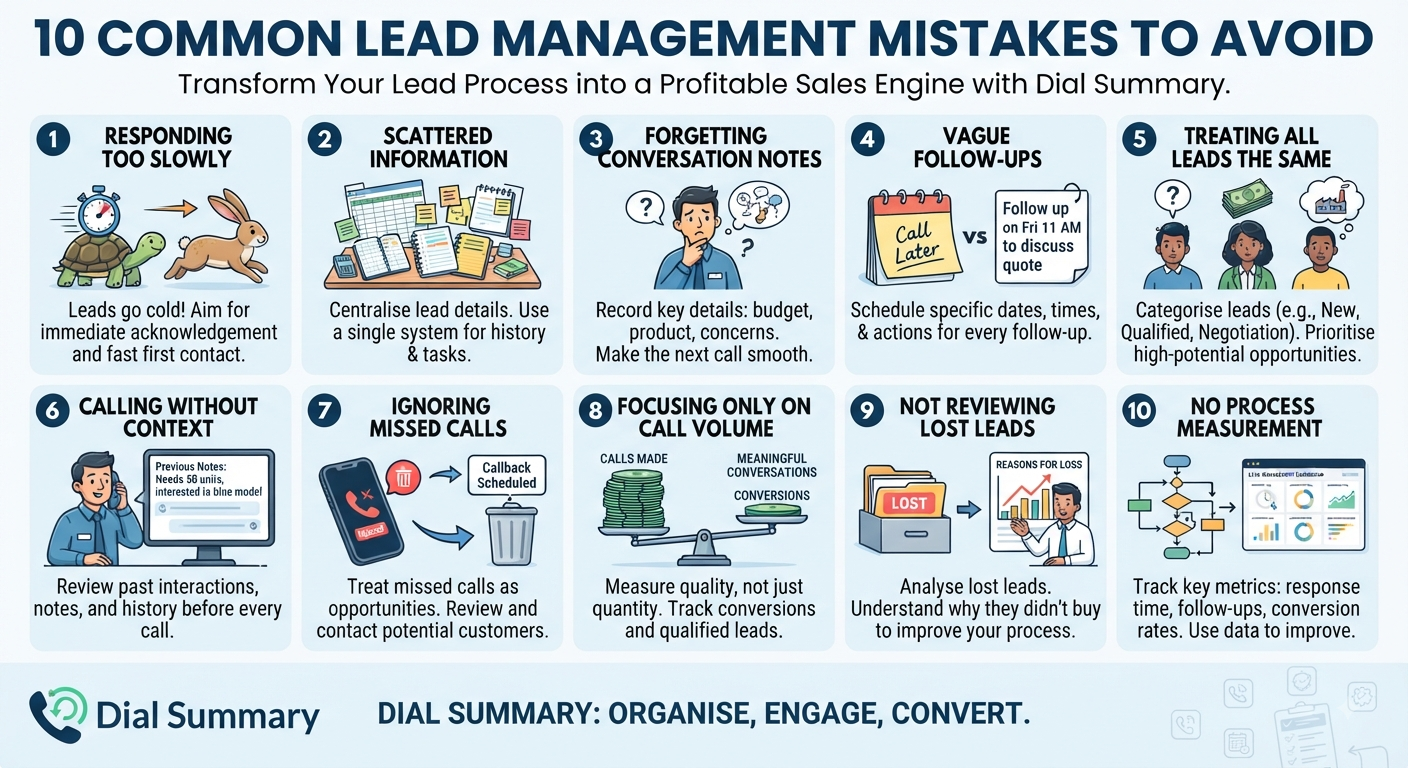
10 Common Lead Management Mistakes Businesses Should Avoid

Generating leads is only the beginning of the sales process. The real challenge is converting those leads into paying customers.

Businesses often spend considerable time and money on advertising, referrals, social media, websites, and calling campaigns but still lose potential customers because their lead management process is not properly organised.

A missed follow-up, incomplete customer record, or delayed response may appear to be a small issue. However, when these problems happen regularly, they can result in lost sales and poor customer experiences.

Here are ten common lead management mistakes businesses should avoid.

1. Responding to New Leads Too Slowly

When a potential customer submits an enquiry, they are usually interested in receiving information quickly. They may also be contacting several businesses at the same time.

If your sales team responds after several hours or days, the customer may have already selected another provider.

Businesses should create a clear process for handling new enquiries:

  • Assign every new lead to a team member.
  • Send an acknowledgement immediately.
  • Make the first call as soon as possible.
  • Record the result of the conversation.
  • Schedule another attempt when the customer does not answer.

A quick response demonstrates professionalism and increases the chance of starting a meaningful conversation.

2. Keeping Lead Information in Different Places

Many teams store customer information across spreadsheets, notebooks, mobile contacts, emails, messaging applications, and individual employee devices.

This creates several problems:

  • Information becomes difficult to find.
  • Multiple employees may contact the same customer.
  • Important notes may remain with one team member.
  • Managers cannot see the complete sales pipeline.
  • Records may be lost when an employee leaves.

A central lead management system gives the entire team access to organised and updated information.

It creates one reliable place for customer details, call history, notes, and follow-up tasks.

3. Failing to Record Conversation Notes

Sales representatives often believe they will remember important details from a customer conversation. However, after handling many calls, it becomes difficult to remember every requirement and commitment.

Without proper notes, the representative may forget:

  • What product the customer requested
  • The customer’s budget
  • Questions asked during the call
  • The preferred time for a callback
  • Documents or quotations that need to be shared
  • The customer’s concerns

Short but clear notes help the next conversation continue smoothly. They also allow another team member to assist the customer when the original representative is unavailable.

4. Not Scheduling the Next Follow-Up

“Call later” is not a complete follow-up plan.

A proper follow-up should include a specific date, time, purpose, and responsible person.

For example:

“Follow up with the customer on Friday at 11:00 AM to discuss the revised quotation.”

This instruction is much more useful than a general note saying “interested customer.”

Every sales conversation should end with a clear next action. If no action is required, the lead status should be updated accordingly.

A structured follow-up process reduces forgotten opportunities and helps representatives plan their daily workload.

5. Treating Every Lead the Same

Not all leads have the same requirements or level of interest. Some customers may be ready to purchase immediately, while others may be researching options for the future.

Treating every lead in the same way can waste valuable sales time.

Businesses can divide leads into practical categories such as:

  • New enquiry
  • Contacted
  • Qualified
  • Follow-up required
  • Demonstration scheduled
  • Quotation shared
  • Negotiation
  • Won
  • Lost
  • Not interested

Representatives can then prioritise leads based on urgency, interest, and the next required action.

6. Making Too Many Calls Without Context

Repeatedly calling customers without understanding previous conversations can create a negative experience.

Customers may become frustrated when they have to explain the same requirements again.

Before making a follow-up call, representatives should review:

  • Previous call notes
  • Lead status
  • Products or services discussed
  • Documents already shared
  • Customer objections
  • Promised actions
  • Last contact date

A well-informed call feels professional and shows the customer that the business values their time.

7. Ignoring Missed Calls

Missed calls are often overlooked because they are not recorded as formal leads. However, a missed call may come from a customer who wants pricing, support, product information, or an immediate purchase.

Teams should review missed calls regularly and attempt to contact unknown or important numbers.

A simple missed-call workflow can include:

  1. Review missed calls several times each day.
  2. Check whether the number belongs to an existing lead.
  3. Assign the callback to the appropriate employee.
  4. Record the callback result.
  5. Create a lead when the caller is a new prospect.

This ensures that valuable inbound opportunities do not disappear.

8. Focusing Only on Call Quantity

A high number of calls does not automatically mean strong sales performance.

Representatives may make many calls without having useful conversations or completing follow-ups.

Managers should evaluate a combination of factors:

  • Total calls
  • Answered calls
  • Meaningful conversations
  • Follow-ups completed
  • Qualified leads
  • Demonstrations scheduled
  • Quotations shared
  • Sales conversions

This provides a more balanced view of performance. It also prevents employees from focusing only on increasing call counts.

9. Failing to Review Lost Leads

Businesses often mark a lead as lost and never review it again. This means they miss an important opportunity to understand why customers did not purchase.

Common reasons may include:

  • Price
  • Missing features
  • Delayed response
  • Poor follow-up
  • Customer selected a competitor
  • Budget was postponed
  • Requirement changed
  • Decision-maker was unavailable

Managers should review lost leads regularly to identify repeated patterns.

If many customers mention the same problem, the business may need to improve its pricing, sales process, communication, or product offering.

Some lost leads may also become future opportunities if contacted at the appropriate time.

10. Not Measuring the Lead Management Process

A business cannot improve a process it does not measure.

Without reporting, managers may not know how many leads are received, contacted, qualified, converted, or lost.

Useful lead management reports may include:

  • Number of new leads
  • Average first-response time
  • Leads contacted successfully
  • Pending follow-ups
  • Overdue follow-ups
  • Qualified lead percentage
  • Conversion rate
  • Average sales cycle
  • Reasons for lost leads
  • Performance by representative

These reports help management identify bottlenecks and make informed improvements.

How to Build a Better Lead Management Process

A reliable process does not need to be complicated. Businesses can begin with a few clear steps.

Step 1: Capture Every Enquiry

Make sure leads from calls, websites, advertisements, referrals, and other sources are recorded.

Step 2: Assign Responsibility

Every lead should have an owner responsible for contacting the customer and updating the record.

Step 3: Respond Quickly

Set a reasonable response target for new enquiries and monitor whether the team follows it.

Step 4: Record Every Interaction

Store important conversation notes, customer requirements, and actions completed.

Step 5: Define Lead Stages

Use clear statuses so everyone understands the current position of each lead.

Step 6: Schedule Specific Follow-Ups

Every pending opportunity should have a next action and due date.

Step 7: Review the Pipeline

Managers should regularly review new leads, overdue tasks, inactive opportunities, and lost leads.

Step 8: Measure Results

Track response time, follow-up activity, qualification, conversion, and reasons for lost business.

How Dial Summary Can Help

Dial Summary helps calling teams organise customer communication and lead-related activity.

It gives employees and managers a structured way to review calls, maintain lead information, and monitor follow-up requirements.

Teams can use Dial Summary to:

  • Review daily call activity
  • Identify missed calls
  • Record and manage leads
  • Maintain customer notes
  • Monitor team performance
  • Track pending follow-ups
  • Improve visibility across calling operations

By connecting call activity with lead management, businesses can reduce manual work and build a more consistent sales process.

Conclusion

Most leads are not lost because customers have no interest. Many are lost because businesses respond slowly, forget follow-ups, misplace information, or fail to understand previous conversations.

An organised lead management process helps teams contact customers at the right time, maintain proper context, and focus on promising opportunities.

Avoiding these ten common mistakes can help businesses protect their marketing investment, improve customer experience, and convert more enquiries into long-term customers.

Share: