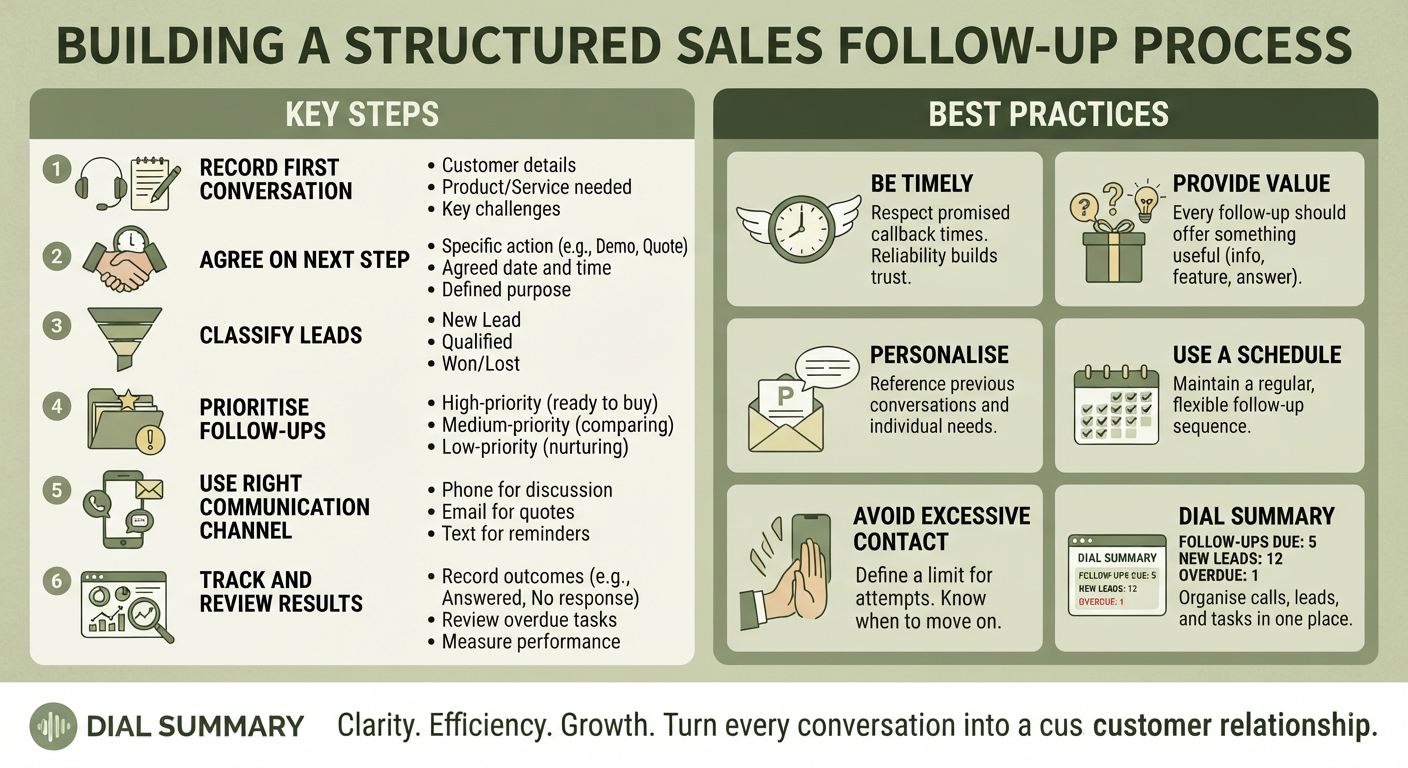
How to Build an Effective Sales Follow-Up Process That Converts More Leads
A successful sales process rarely ends after the first conversation. Many potential customers need additional information, time to compare options, approval from decision-makers, or multiple discussions before they are ready to make a purchase.
This is why follow-up is one of the most important parts of sales.
However, effective follow-up does not mean repeatedly calling customers without a plan. It means contacting the right prospect at the right time, with useful information and a clear understanding of the previous conversation.
A structured sales follow-up process helps businesses stay organised, build customer trust, and convert more leads into paying customers.
Why Sales Follow-Up Matters
A customer may show genuine interest but still not make an immediate decision.
There may be several reasons:
- They need approval from a manager or business partner.
- They want to compare different providers.
- They are waiting for a quotation.
- Their budget will become available later.
- They need a product demonstration.
- They have unanswered questions.
- They are currently busy.
- The requirement is important but not urgent.
If the sales representative does not follow up, the opportunity may be forgotten. Another company may contact the customer at the right time and win the sale.
Follow-up keeps the conversation active and shows customers that the business is attentive and dependable.
Record the First Conversation Properly
A strong follow-up process begins during the first conversation.
The representative should record the information required for the next interaction.
Important details may include:
- Customer name and company
- Phone number and email address
- Product or service required
- Customer’s main objective
- Budget expectations
- Current challenges
- Questions or objections
- Decision-making process
- Preferred communication method
- Suitable callback date and time
- Information promised by the representative
These notes help the representative continue the conversation without asking the customer to repeat everything.
Agree on the Next Step
Whenever possible, the next action should be agreed upon before ending the call.
Instead of saying:
“I will contact you later.”
Use a specific statement:
“I will send the quotation today and call you on Thursday at 3:00 PM to answer any questions.”
A clear next step creates accountability for the representative and gives the customer a better experience.
The next action may include:
- Sending a brochure
- Sharing a quotation
- Arranging a demonstration
- Scheduling a technical discussion
- Contacting another decision-maker
- Calling after a specific date
- Providing additional documents
- Starting a trial or onboarding process
Classify Leads by Their Current Stage
Sales representatives should know the current position of every opportunity. Lead stages make it easier to decide what action is required.
A simple sales pipeline may include:
- New lead
- First contact attempted
- Contacted
- Qualified
- Demonstration scheduled
- Quotation shared
- Follow-up required
- Negotiation
- Won
- Lost
Every stage should have a clear meaning. Team members should understand when and why a lead should be moved from one stage to another.
A well-defined pipeline prevents leads from remaining inactive without explanation.
Prioritise Follow-Ups
Not every follow-up has the same urgency. Representatives should prioritise tasks based on customer interest and required action.
High-priority follow-ups may include:
- Customers who requested an immediate callback
- Prospects waiting for a quotation
- Demonstrations scheduled for the current day
- Customers who asked specific purchasing questions
- Leads near the final decision stage
- Existing customers reporting an urgent issue
Medium-priority follow-ups may include:
- Interested customers comparing options
- Prospects waiting for internal approval
- Leads requiring additional information
- Customers who asked to be contacted later in the week
Lower-priority follow-ups may include:
- Long-term opportunities
- Customers with no confirmed requirement
- Leads that have not responded after several attempts
Prioritisation helps representatives focus on opportunities that are most likely to move forward.
Contact Customers at the Promised Time
If a representative promises to call on a particular day, that commitment should be respected.
Timely follow-up shows that the business is organised and reliable.
Delayed follow-up can make customers question whether they will receive good service after making a purchase.
Representatives should use reminders or follow-up dashboards to review upcoming tasks at the beginning of each day.
A practical daily routine may include:
- Review overdue follow-ups.
- Check tasks scheduled for today.
- Prioritise high-value opportunities.
- Complete promised calls and messages.
- Record the result of every interaction.
- Schedule the next action where necessary.
Use the Right Communication Channel
Not every customer prefers phone calls. Some may prefer email, WhatsApp, SMS, or a scheduled online meeting.
Representatives should use the communication method that is appropriate for the customer and the situation.
Phone calls are useful for:
- Understanding requirements
- Handling objections
- Discussing pricing
- Negotiating
- Building relationships
Email is useful for:
- Sending quotations
- Sharing detailed information
- Providing formal confirmation
- Sending documents
- Maintaining a written record
WhatsApp or SMS may be useful for:
- Short reminders
- Meeting confirmation
- Sharing quick updates
- Confirming callback times
Businesses should also respect customer consent and applicable communication rules.
Provide Value in Every Follow-Up
Customers may lose interest when every follow-up contains the same question:
“Have you made a decision?”
A better follow-up provides something useful.
For example, the representative may:
- Answer a question from the previous call.
- Share a relevant product feature.
- Provide a customer success example.
- Send a comparison document.
- Explain the implementation process.
- Clarify pricing.
- Share a useful guide.
- Offer a product demonstration.
Value-based follow-ups make the conversation more helpful and less repetitive.
Personalise the Conversation
Generic messages are easy to ignore. A personalised follow-up shows that the representative understands the customer’s requirement.
Instead of writing:
“Hello, I am following up regarding our product.”
Write:
“Hello Mr. Sharma, during our conversation on Monday you mentioned that your sales team needs better visibility into missed calls and pending follow-ups. I am sharing the relevant workflow and would be happy to demonstrate it.”
Personalisation does not need to be complicated.
Mentioning the customer’s requirement, previous question, or agreed next step can make the communication more meaningful.
Use a Consistent Follow-Up Schedule
There is no single schedule that works for every business. The right frequency depends on the product, customer, sales cycle, and urgency.
A general follow-up sequence may look like this:
- Day 0: Respond to the enquiry and complete the first conversation.
- Day 1: Send promised information or a short summary.
- Day 3: Call or message to answer questions.
- Day 7: Share additional information or arrange a demonstration.
- Day 14: Confirm whether the requirement is still active.
- Day 30: Move the lead into a longer-term follow-up process if no immediate decision is expected.
The schedule should remain flexible.
If the customer requests a particular date, their preference should take priority.
Avoid Excessive Follow-Up
Persistence is important, but repeatedly contacting an unresponsive customer can damage the business relationship.
The team should define a reasonable number of attempts.
After several unanswered calls or messages, the representative can send a final communication such as:
“We have tried to reach you regarding your enquiry. We understand that your priorities may have changed. Please contact us whenever you would like to continue the discussion.”
The lead can then be moved to an inactive or long-term follow-up stage.
This keeps the database organised while leaving the door open for future communication.
Track Every Follow-Up Result
Every attempt should produce an updated record.
Possible outcomes may include:
- Customer answered
- No response
- Callback requested
- Information shared
- Demonstration scheduled
- Quotation requested
- Negotiation in progress
- Decision postponed
- Not interested
- Incorrect contact details
- Sale completed
Accurate outcomes help managers understand what is happening in the pipeline. They also prevent unnecessary repeated calls.
Review Overdue Follow-Ups
Overdue tasks are a warning that sales opportunities may be at risk.
Managers and representatives should review overdue follow-ups every day. They should identify why the task was not completed and decide whether it should be reassigned, rescheduled, or closed.
A regular review helps answer important questions:
- Are representatives managing too many leads?
- Are reminders being ignored?
- Are some leads assigned to unavailable employees?
- Are high-priority customers being delayed?
- Does the sales process require additional support?
The objective is to improve the process, not simply blame employees.
Measure Follow-Up Performance
Businesses should track whether their follow-up process is producing results.
Useful measurements include:
- Average first-response time
- Number of follow-ups completed
- Number of overdue follow-ups
- Customer response rate
- Demonstrations scheduled
- Quotations shared
- Lead conversion rate
- Average time required to close a sale
- Leads lost because of delayed response
- Performance by sales representative
These measurements help managers identify improvements and provide targeted coaching.
How Dial Summary Supports Follow-Up Management
Dial Summary helps calling teams connect call activity with lead and follow-up information.
Teams can use Dial Summary to:
- Review recent and missed calls
- Organise customer details
- Record conversation notes
- Track lead stages
- Monitor pending follow-ups
- Review calling activity
- Improve team visibility
- Maintain a more consistent sales workflow
By keeping important information organised, representatives can prepare for conversations and avoid losing track of customer commitments.
Conclusion
Effective follow-up is not about making the maximum number of calls. It is about continuing customer conversations with the right timing, context, and purpose.
A structured process helps representatives remember commitments, prioritise important opportunities, and provide useful information. It also gives managers better visibility into the sales pipeline.
When every lead has a clear owner, status, next action, and follow-up date, the sales team can work more consistently and customers receive a more professional experience.